
India's Healthcare Decade:Why Demand May Outpace Supply for Years

Over the last three decades, some of India's most successful investment themes have emerged from long-term structural changes in the economy. Information technology benefited from globalization, while FMCG players scaled rapidly on the back of increasing consumption fuelled by rising incomes and urbanization. Today, we believe healthcare represents one of the most compelling long-term structural opportunities in the Indian economy. It extends far beyond hospitals, encompassing an integrated ecosystem of pharmaceuticals, diagnostics, medical devices, health insurance, and digital health services, each playing a critical role in improving healthcare access, affordability, and patient outcomes.

India's healthcare ecosystem is estimated at approximately US$291 billion in FY25 and is projected to reach US$700 billion by 2030, representing a CAGR of around 19%. This growth is expected to be supported by rising healthcare expenditure, expanding insurance coverage, increasing demand for organised healthcare services and continued investments across the healthcare value chain.

Unlike sectors that are closely tied to consumer sentiment or capital expenditure cycles, healthcare demand tends to remain resilient across economic cycles. Whether the economy grows at 6% or 8%, people continue to require treatment, surgeries, diagnostics and preventive care. More importantly, India's healthcare demand is supported by structural drivers such as a large and aging population, rising incomes, increasing prevalence of chronic diseases, expanding insurance coverage and a significant shortage of healthcare infrastructure. Together, these factors position healthcare as one of India's most compelling long-term structural growth stories.
The graph below depicts the breadth and composition of India’s healthcare ecosystem, highlighting the relative size of key segments including hospitals, diagnostics, pharmaceuticals and life sciences, medical devices, insurance, and other healthcare services. It also illustrates the significant role of private-sector participation across the value chain, underscoring that India’s healthcare opportunity extends well beyond hospitals alone.

Across countries, healthcare spending tends to increase alongside rising income levels, reflecting greater affordability, stronger public investment and broader health insurance coverage. Despite being the world's fastest-growing major economy, India's healthcare spending remains relatively low at around US$135 per capita, significantly below peers such as China, Brazil and Thailand. As India's GDP per capita is expected to increase from around US$2,700 in 2025 to approximately US$4,000 by 2030, healthcare spending per capita is projected to more than double to around US$300, reflecting the country's substantial headroom for healthcare expenditure.

India’s demographic profile is also undergoing a structural shift that could significantly increase healthcare demand over the coming decades. India’s population is expected to remain above 1.5 billion for much of this period, while the share of people aged 60 years and above is projected to nearly double to around 20% by 2050. At the same time, life expectancy is projected to increase from 67 years in 2021 to 84 years by 2045, while the median age is expected to rise from 28.8 years in 2025 to 38.3 years by 2050. As healthcare utilisation typically increases with age, a larger and older population is expected to drive sustained demand for hospitals, diagnostics, specialty care, chronic disease management, rehabilitation, long-term care and other age-related healthcare services.

The most compelling aspect of India's healthcare story is the country's persistent infrastructure deficit. Despite significant improvements over the past two decades, India's healthcare infrastructure continues to lag global benchmarks, creating one of the largest long-term investment opportunities within India's healthcare sector.
India has only around 1.6 hospital beds, 0.7 doctors and 1.8 nurses per 1,000 population, well below the levels seen in many emerging and developed healthcare systems. The shortage extends beyond physical infrastructure to healthcare manpower, creating structural capacity constraints across the healthcare ecosystem.

Estimates suggest the country may need 1.3–2.8 million additional hospital beds, around 1 million more doctors and approximately 3.5 million additional nurses by 2030 to move closer to global benchmarks.
Bridging this infrastructure gap will require sustained public and private investment over the coming decade. This creates a long runway for organised healthcare providers to expand capacity through greenfield projects, brownfield expansions and deeper penetration into under-served Tier-2 and Tier-3 cities.
India's healthcare demand is no longer driven solely by infectious diseases. Lifestyle-related conditions such as diabetes, cardiovascular diseases, obesity, hypertension and cancer are becoming increasingly prevalent across both urban and semi-urban populations, fundamentally reshaping the country's healthcare needs.
India is home to nearly 90 million adults living with diabetes, giving it the world's second-largest diabetes burden after China. According to the International Diabetes Federation (IDF), this number is projected to increase to approximately 157 million by 2050, underscoring the country's rapidly growing burden of chronic diseases. Unlike acute illnesses, chronic diseases require lifelong treatment, regular diagnostics, specialist consultations and continuous medical supervision.
As healthcare shifts from treating acute illnesses to managing chronic diseases, financing healthcare becomes just as important as expanding healthcare capacity. Rising health insurance penetration is therefore expected to play a transformative role in improving affordability and expanding access to quality healthcare. Today, private health insurance, employer-sponsored plans and government initiatives are steadily improving healthcare access and affordability. Despite these developments, India's health insurance ecosystem remains underpenetrated relative to its healthcare needs.
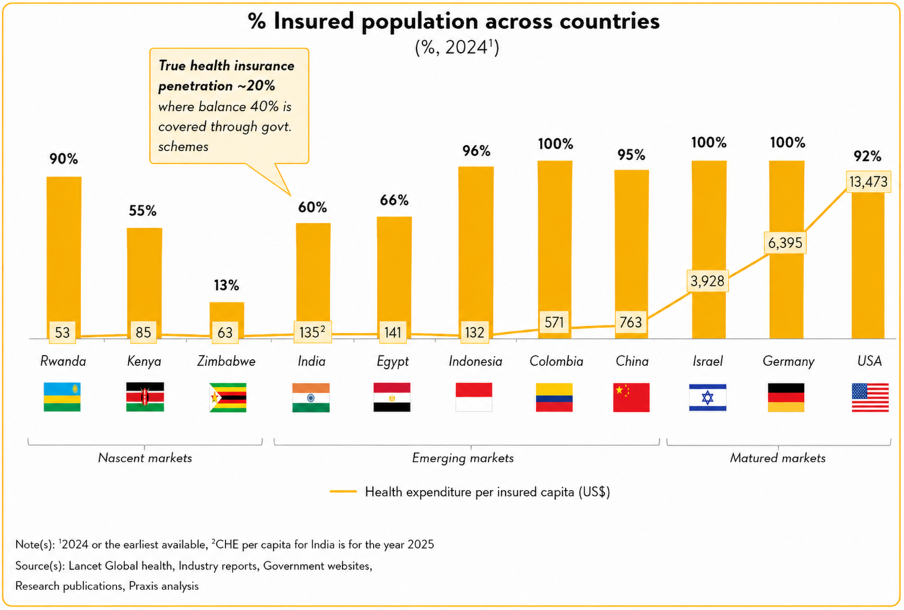
While nearly 60% of the population is covered through a combination of government-sponsored schemes and private insurance, true private health insurance penetration remains only around 20%, highlighting significant scope to deepen insurance coverage and strengthen healthcare financing.
Cross-country comparisons further highlight India's long-term opportunity. Countries with lower out-of-pocket healthcare spending generally rely on a combination of government-funded healthcare and mandatory insurance, while voluntary insurance contributes only a modest share of total healthcare financing. Although India's out-of-pocket expenditure has declined to around 44% of total healthcare spending from nearly 70% two decades ago, it remains substantially higher than in many peer economies. Continued expansion of insurance coverage and pooled healthcare financing will be critical to improving affordability, increasing healthcare utilisation and supporting sustainable growth across hospitals, diagnostics and the broader organised healthcare ecosystem.

The health insurance industry is already witnessing strong momentum. Total Indian health insurance premiums increased to US$13.84 billion in FY25 from US$ 7.04 billion in FY20, reflecting growing awareness, rising healthcare costs and increasing insurance adoption.

As insurance coverage expands and more patients shift towards organised healthcare providers, scale, quality of care and operational efficiency are becoming increasingly important. These changing patient preferences are expected to accelerate consolidation across India's fragmented healthcare industry as explained below.
India’s hospital market still remains highly fragmented. Of the approximately 55,000 hospitals operating across the country, more than 80% are standalone facilities, resulting in limited economies of scale, varying standards of care and lower operating efficiencies. This fragmentation, however, presents a significant opportunity for organised hospital chains. As patients increasingly seek better infrastructure, specialist expertise, advanced medical technology and more consistent standards of clinical care, demand is gradually shifting towards organised providers. Over time, this transition could drive greater consolidation across the industry, enabling established hospital chains to expand their networks, improve utilisation and capture a larger share of India’s growing healthcare expenditure.
Leading hospital chains are already steadily expanding their presence across multiple states through greenfield developments, brownfield expansions and strategic acquisitions, transforming what was once a predominantly regional industry into a more organised national healthcare network. While these hospital groups have established a strong presence in India's major metropolitan cities, the next phase of growth is increasingly expected to come from Tier-2 and Tier-3 cities, where healthcare demand is rising rapidly but quality healthcare infrastructure remains underpenetrated.

Nearly 65% of India's population resides outside major metropolitan areas, while advanced healthcare infrastructure continues to be concentrated in urban centres. This imbalance presents a significant expansion opportunity for organised hospital chains to establish a stronger presence in underpenetrated markets, where healthcare demand is rising faster than the creation of new capacity. As access to organised healthcare expands beyond major cities, the demand for supporting healthcare services is also expected to grow, with diagnostics emerging as a key beneficiary of this transition.
The diagnostic sector is becoming an increasingly important pillar of modern healthcare, playing a critical role in early disease detection, treatment planning and ongoing disease monitoring. From routine blood tests and pathology to advanced imaging, diagnostic services are integral to improving clinical outcomes and enabling more timely medical intervention. As healthcare access expands and the focus gradually shifts from reactive treatment towards preventive care and early disease management, the frequency and breadth of diagnostic testing are expected to increase, positioning diagnostics as one of the key growth segments within India’s healthcare ecosystem.

From the graph above, despite rising healthcare awareness, diagnostic testing still remains significantly underpenetrated in India. The average Indian undergoes only around two diagnostic tests per year, compared with more than 17 tests in Germany and over 20 in the United States. This large gap underscores a significant headroom for growth.
Moreover, India's diagnostics industry remains highly fragmented, with standalone diagnostic centres and hospital-based laboratories continuing to dominate the market, while organised diagnostic chains account for only around 20–25% of the total market. With more than 1.3 lakh diagnostic laboratories operating across the country, the industry presents a significant opportunity for consolidation and market share gains by large well-organised players.
Technology: Improving Healthcare Delivery:
Technology is emerging as one of the key enablers of India's healthcare transformation, improving clinical outcomes, enhancing operational efficiency and expanding access to quality care. Organised healthcare providers are increasingly investing in robotic-assisted surgery, advanced imaging systems, digital pathology and electronic health records (EHRs) to improve diagnostic accuracy, streamline clinical workflows and deliver better patient outcomes.
India's digital health ecosystem is also evolving rapidly. Under the Ayushman Bharat Digital Mission (ABDM), more than 790 million ABHA digital health IDs have been created, while over 560 million health records have been digitally linked, enabling seamless and secure sharing of patient information across healthcare providers. These digital initiatives are improving care coordination, reducing administrative inefficiencies and laying the foundation for a more integrated healthcare ecosystem.
For organised healthcare providers, continued investments in medical technology and digital infrastructure are expected to improve operational efficiency, enhance patient outcomes and strengthen competitive advantages. Beyond improving care within hospitals, technology is also expanding access to healthcare through telemedicine, enabling specialist consultations to reach Tier-2, Tier-3 and rural India.
India's telemedicine market is projected to grow from approximately US$4.5 billion in 2026 to over US$12.6 billion by 2031, representing a CAGR of around 23%, driven by rising smartphone penetration, improved internet connectivity and increasing adoption of digital healthcare services.

While virtual consultations cannot replace physical hospitals, they complement the healthcare ecosystem by improving access to specialist consultations, enabling follow-up care and facilitating timely referrals. Leading healthcare institutions, including AIIMS and Narayana Health, have already integrated telemedicine into their service offerings, reflecting the growing role of digital health in expanding healthcare access.
While technology is making healthcare more accessible within India, the country's reputation for delivering high-quality care at competitive costs is also attracting a growing number of international patients.
Medical Tourism: India's Global Cost Advantage:
India has emerged as one of the world's leading destinations for medical value travel. Patients from Africa, the Middle East, South Asia and other regions increasingly choose India for complex medical procedures owing to its combination of highly skilled medical professionals, internationally accredited hospitals and affordable treatment costs.

India has established one of the world's most cost-efficient healthcare delivery ecosystems, offering complex procedures such as joint replacements, cardiac surgeries and angioplasty at 60–90% lower costs than many developed markets while maintaining globally competitive standards of care. Supported by experienced medical professionals, high procedural volumes and efficient hospital operating models, India ranks 10th globally in the Medical Tourism Index (MTI), while ranking 3rd for cost competitiveness and 6th for quality of healthcare services, reinforcing its position as a preferred destination for medical value travel.
Following the sharp decline in international patient arrivals during the COVID-19 pandemic, medical tourism has recovered to near pre-pandemic levels. In 2025, India welcomed more than 5 lakh foreign patients for medical treatment, accounting for approximately 5.5% of the country's total foreign tourist arrivals. The Indian medical tourism market is estimated at US$8.7 billion in 2025 and is projected to reach approximately US$16.2 billion by 2030, reflecting a CAGR of over 13%.
As healthcare infrastructure continues to improve and hospital capacity expands, India is well positioned to strengthen its position as a global healthcare destination, creating an additional long-term growth avenue for organised hospital chains.
Policy Support: Strengthening India's Healthcare Ecosystem
Government policy continues to play a pivotal role in strengthening India's healthcare ecosystem by improving affordability, expanding healthcare access and encouraging private sector participation.
Union Budget 2026–27:
The Union Budget 2026–27 allocated ₹1,06,530 crore (US$12.05 billion) to the Ministry of Health and Family Welfare, representing a 10% increase over the Revised Estimates for FY2025–26. The higher allocation underscores the government's continued focus on strengthening healthcare infrastructure, expanding access and improving public health outcomes.
Ayushman Bharat – Pradhan Mantri Jan Arogya Yojana (AB-PMJAY):
The allocation for AB-PMJAY was increased to ₹9,500 crore in the Union Budget 2026–27, up 5.6% over the previous year's revised estimates. As of August 2026, more than 45 crore Ayushman Cards had been issued and over 38,000 hospitals had been empanelled under the scheme. Continued expansion of government-backed health insurance is expected to improve affordability and increase healthcare utilisation.
National Health Mission (NHM):
The National Health Mission received an allocation of ₹39,390 crore in the Union Budget 2026–27, a 6.2% increase over the revised estimates for FY2025–26. The programme continues to strengthen primary healthcare, maternal and child health services, disease control and healthcare delivery across rural and urban India.
GST 2.0 reforms:
Recent GST reforms are expected to improve healthcare affordability through GST exemption on eligible health insurance premiums and lower GST on several essential medical devices and consumables, including diagnostic kits, reagents, glucometers and medical oxygen. These measures are expected to reduce healthcare costs and improve access to quality healthcare.
Foreign Direct Investment (FDI):
India permits 100% FDI under the automatic route for greenfield healthcare projects and 100% FDI under the government approval route for brownfield investments. This liberal investment framework continues to support long-term capital inflows across hospitals, diagnostics, pharmaceuticals and medical devices.
What makes India’s healthcare sector particularly attractive from an investment perspective is the convergence of multiple long-term structural drivers. A large and ageing population, rising incomes, expanding insurance coverage and the growing burden of chronic diseases are collectively driving higher and more recurring healthcare utilisation. At the same time, a significant infrastructure gap is creating the need for sustained capacity expansion, while organised healthcare providers continue to gain market share in a highly fragmented industry. Unlike sectors that are heavily influenced by discretionary consumption or capital expenditure cycles, healthcare demand tends to remain relatively resilient across economic cycles. Together, these forces create a powerful structural growth runway that could shape India’s healthcare landscape for decades.
As India progresses towards becoming one of the world’s largest economies, the need for a deeper and more sophisticated healthcare ecosystem will only intensify. While markets often focus on short-term earnings and quarterly performance, some of the most rewarding investment opportunities can emerge from identifying structural trends early and remaining invested as they unfold. At Prosperity Wealth Management, our investment philosophy is centred on identifying such long-term opportunities and investing in well-managed businesses with durable competitive advantages and the ability to compound earnings over time. We believe India’s healthcare sector represents one such opportunity.
Kind Regards,
Research Desk,
Team PWM.
Disclaimer: This article is intended solely for informational and educational purposes and should not be construed as investment advice, investment research, a recommendation, or a solicitation to buy, sell, or hold any security or investment product. References to specific companies, sectors, industries, or securities are provided solely to illustrate broader market themes and should not be interpreted as recommendations or indications of future performance. The views and opinions expressed are based on publicly available information, interactions with company management where applicable, and internal analysis as of the date of publication, such views are subject to change without notice. While reasonable care has been taken in the preparation of this material, Prosperity Wealth Management Pvt. Ltd. (PWM) does not make any representation or warranty, express or implied, regarding the accuracy, completeness, or reliability of the information contained herein. Past performance is not indicative of future results, and investments in securities are subject to market risks, including the possible loss of principal. Readers are advised to conduct their own independent research, assess their financial objectives and risk tolerance, and consult their financial, legal, and tax advisors before making any investment decisions. Readers act at their own discretion. PWM accepts no liability for any losses or consequences arising from the use of this article or any investment decisions based on it.


Comments